
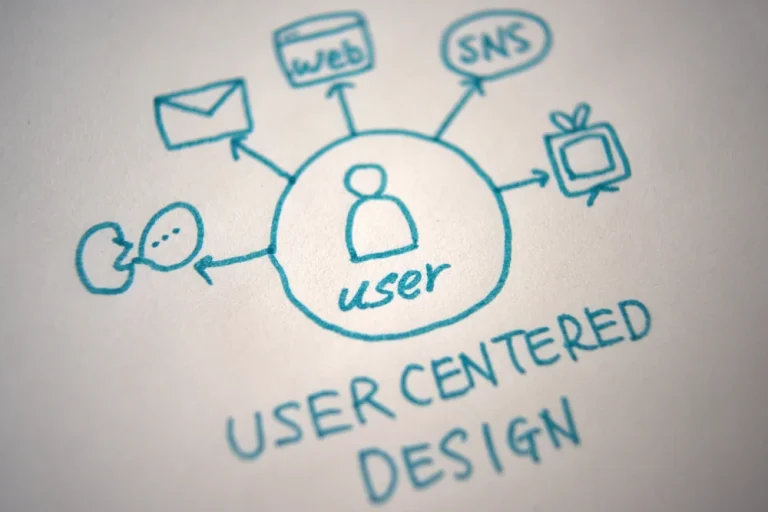
USER CENTERED DESIGN
User-Centered Design (UCD) in web usability is an approach that places the needs, preferences, and limitations of the end-users at the core of the design process.
The goal is to create websites that are intuitive, easy to navigate, and meet user expectations, making their interaction with the site smooth and satisfying.
THE ROLE OF USER CENTERED DESIGN IN USABILITY
Jakob Nielsen defines usability with five key components: learnability, efficiency, memorability, error prevention, and satisfaction.
These components form the foundation of UCD and ensure that websites are not only functional but also intuitive and easy to navigate. A UCD approach emphasizes research and iterative design, where users’ feedback actively shapes the product’s development.
This approach helps to reduce friction in user interactions, increase satisfaction, and enhance overall usability.
How to Integrate User Centered Design into Web Design
Gather Information about the target audience through methods like interviews, surveys, and analytics. This research helps to define user goals, needs and potential challenges.
Develop user personas based on research to represent key segments of the target audience, Personas help guide design decisions.
User flows visualize the steps users take to accomplish specific tasks on a website. This helps identify potential bottlenecks and ensures a logical, intuitive progression from one action to the next.
Create basic wireframes to outline layouts and more complex wireframes for more detailed interactions.
Wireframes are essential for aligning design with user expectations and for early testing.
Steve Krug who is a UX professional, emphasizes the importance of usability testing as a continuous part of UCD.
Testing prototypes with real users helps identify usability issues before a website’s launch.
Usability tests should be simple and repeated often to gather feedback and refine the design.
Successful Examples of User Centered Design
Google’s homepage and search engine interface are prime examples of effective UCD. With a minimalistic layout and intuitive search bar, Google’s design puts the user’s search needs front and centre. By focusing on simplicity and responsiveness, Google has created a highly accessible interface with a familiar and consistent experience that users can navigate with ease.
Apple’s website and products are designed with UCD principles that emphasize accessibility, intuitiveness, and user satisfaction. From their product pages to the Apple Store interface, Apple’s websites make use of clear navigation, consistent design, and easily accessible information. Apple’s attention to user-centred details, such as touch gestures on mobile devices, has helped them build a highly engaged user base